New collection pieces trace the silences of history
9 December 2025
Ratri Notosudirdjo, Sandim Mendes and Ayo delved into the sample books of the Leidsche Katoenmaatschappij, joining discussions on the impact of patterns copied from overseas. They were drawn, above all, to what was missing, and created installations that break through colonial silences
Over the past eighteen months, three artists have worked closely with the museum’s curators, the lab team and external advisor Professor Rolando Vázquez Melken to explore the collection of the Leidsche Katoenmaatschappij (LKM). The sample and recipe books, textile objects and archives of this textile factory – run by the Driessen family in the late nineteenth and early twentieth centuries – form the foundation of today’s museum. Acquired by the municipality of Tilburg in the 1950s, these holdings were entrusted to the TextielMuseum, which opened its doors in 1958, then still housed in a manufacturer’s villa on the Gasthuisring.
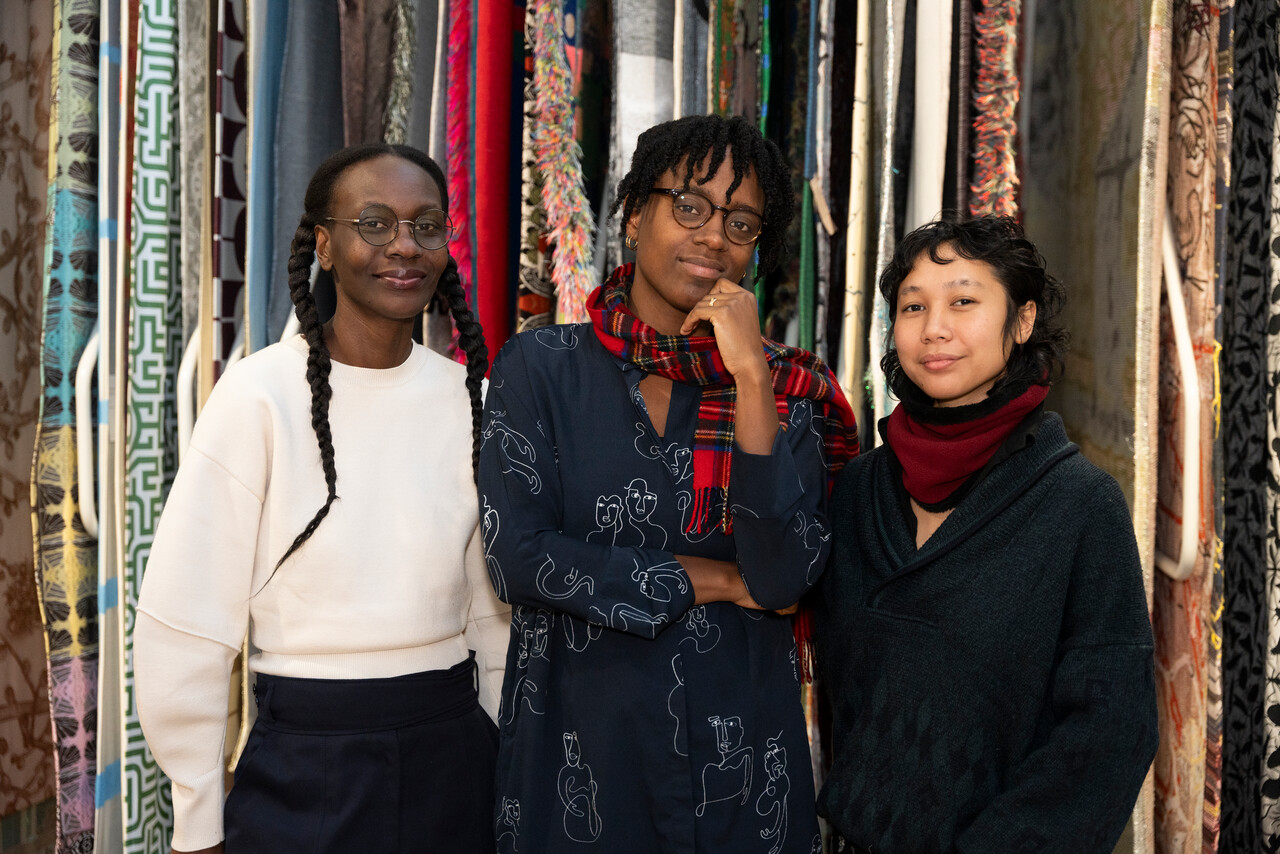
Artists Ayo, Sandim Mendes en Ratri Notosudirdjo. Photo by Patty van den Elshout.
Imitation batiks
Today, this collection is viewed very differently from how it was perceived at the time. The Leidsche Katoenmaatschappij operated within a system of colonial exploitation. The success of the Driessen family’s trade was built on the copying of other cultures’ heritage. Original, handmade batiks from Indonesia were industrially reproduced in the Netherlands as machine-printed textiles. These imitation batiks were then sold on a large scale in, among other places, Asia, Africa and Suriname.
Torn from their cultural context
While the technical specifications are meticulously recorded in the seventy sample and recipe books in the collection, little has been written about the origins and meanings of the patterns themselves. The Driessens travelled the world, collecting fabrics and dyes to replicate and sell – not to preserve or share the stories behind them. “Many of these samples have been torn from their cultural context,” says museum curator Adelheid Smit. “So much of the bigger picture remains unknown. What knowledge and recognition have been lost along the way?”
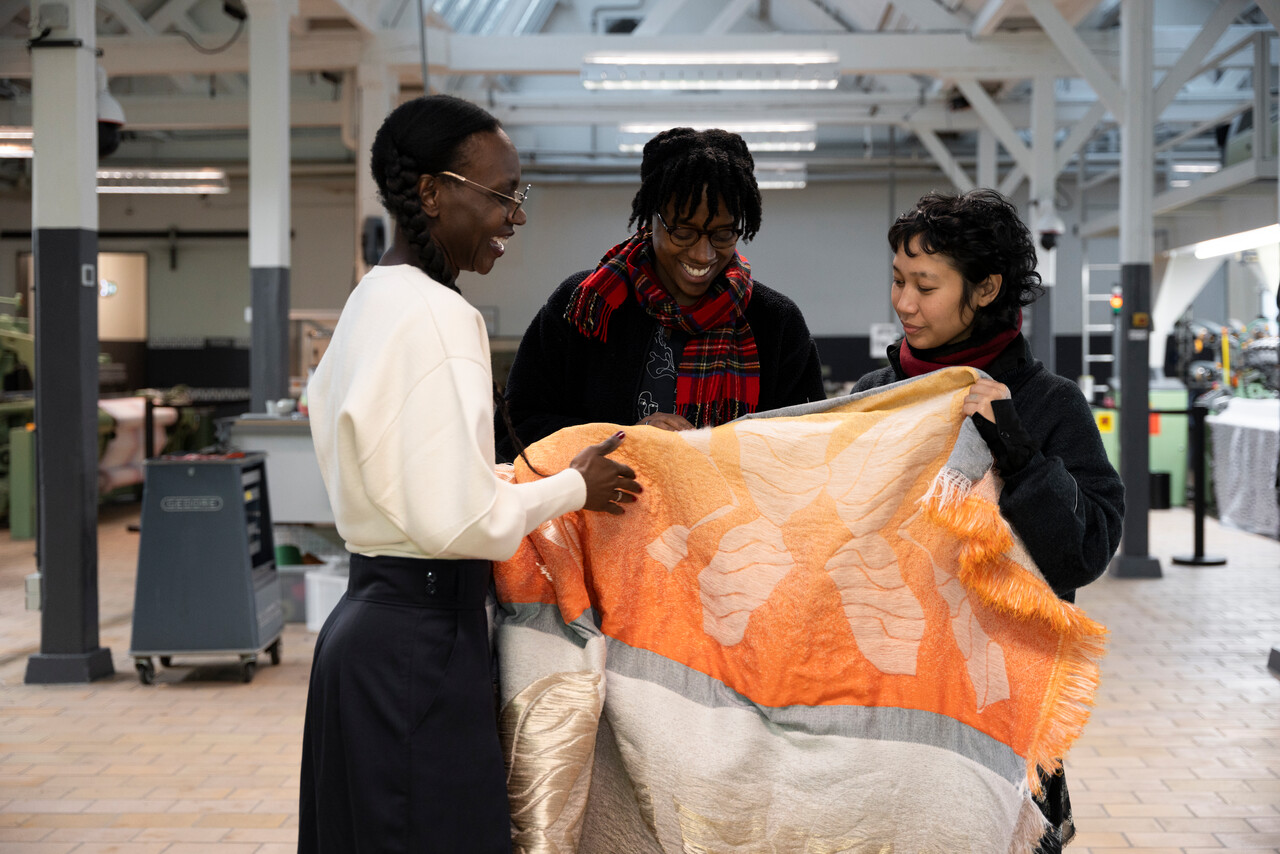
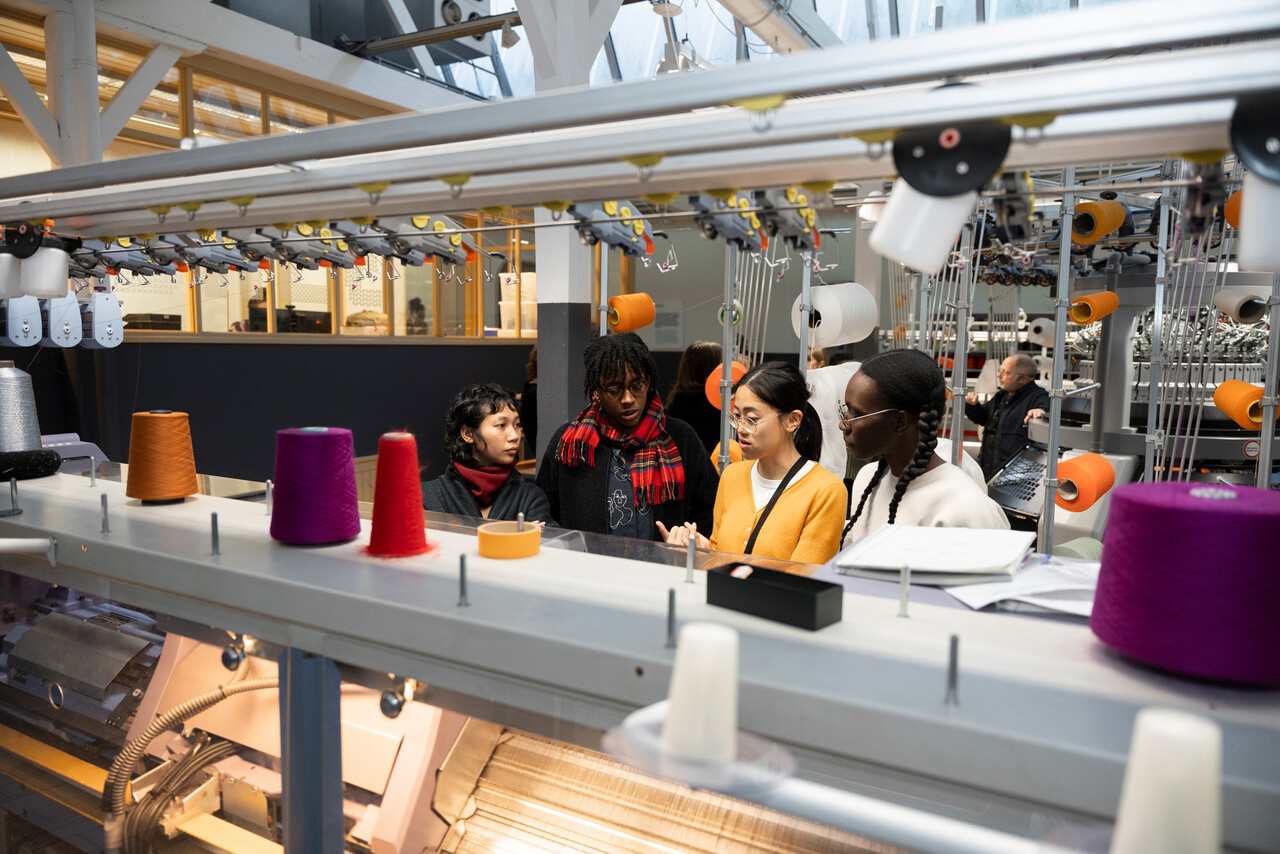
Artists Ayo, Sandim Mendes and Ratri Notosudirdjo in the TextielLab. Photo door Patty van den Elshout.
A decolonial gaze
Research into the cultural context of this historical collection has been ongoing for some time, but with the support of the Mondriaan Fund the museum was able to take the project a step further. For the 2024 and 2025 collection commissions, artists Ratri Notosudirdjo, Sandim Mendes and Ayo were invited to approach the collection through a decolonial lens and to develop new works for the collection in response. What makes this trajectory distinctive is that the first six months were devoted to shared research, involving not only the artists but also lab specialists and curators.
Collective learning process
In a series of sessions led by Rolando Vázquez Melken, Professor of Post/Decolonial Theories and Literatures at the University of Amsterdam, the collection was examined and the impact of the Leidsche Katoenmaatschappij’s trading practices explored. “We want to look honestly and openly at what preceded our collection,” says Smit, who is curating the exhibition in which the new works will be presented. She describes the sessions under Vázquez’s guidance as a unique collective learning process. “Rolando has an exceptional ability to shift perspectives and to centre non-Western cultures and experiences. As a result, the museum’s Eurocentric gaze became palpably apparent. We are used to focusing on what is visible, rather than on what is absent. Initially, we failed to see just how fragmented and detached these patterns are from their original use and meaning. Through this research, we became aware of the gaps in the story.”
Visibility and recognition
Met dit soort onderzoeksprojecten wil het TextielMuseum de misstanden uit de koloniale geschiedenis niet ‘goedmaken’, maar wel zichtbaarheid en erkenning creëren voor de originele makers. “Met deze opdrachten hopen we een aanzet te kunnen doen tot een dekoloniale duiding van collecties, en van onze textiele collectie in het bijzonder,” aldus Smit. “We willen connecties herstellen, verleden aan heden verbinden en uitgewiste geschiedenissen en stemmen weer laten klinken.”
Mechanical reproduction
The process undertaken with Notosudirdjo, Mendes and Ayo marks an important step in this direction. During the research phase, the artists were particularly inspired by the broken relationships embodied in the sample books. The samples reveal how the hand of the original batik makers was erased by the Leidsche Katoenmaatschappij’s mechanical reproductions. Only after the group sessions and impact research did the artists select their techniques and designs. The role of industrial production in the TextielLab was itself a subject of reflection, Smit notes: “We discussed at length what it means to once again produce this work here, using industrial machines.”
Breaking silences
The installations that emerged from this phased process will not be presented to the public in their full form until 2027. In the run-up to the exhibition, however, the stories of the makers will be shared over the coming period. The artists have created immersive installations using textiles and other materials, drawing connections to their roots in Indonesia, Cape Verde and Uganda. Strikingly, all three have incorporated sound into their work. “Prompted by the LKM collection and inspired by the Indigenous cultures of their ancestors, they forge new connections and break through silences,” says Smit. “This entire process has helped us, as a museum, to stop seeing objects merely as sources of information, and to recognise them instead as things that resonate.”
Text Willemijn de Jonge

The collection commissions were realised with the financial support of the Mondriaan Fund.