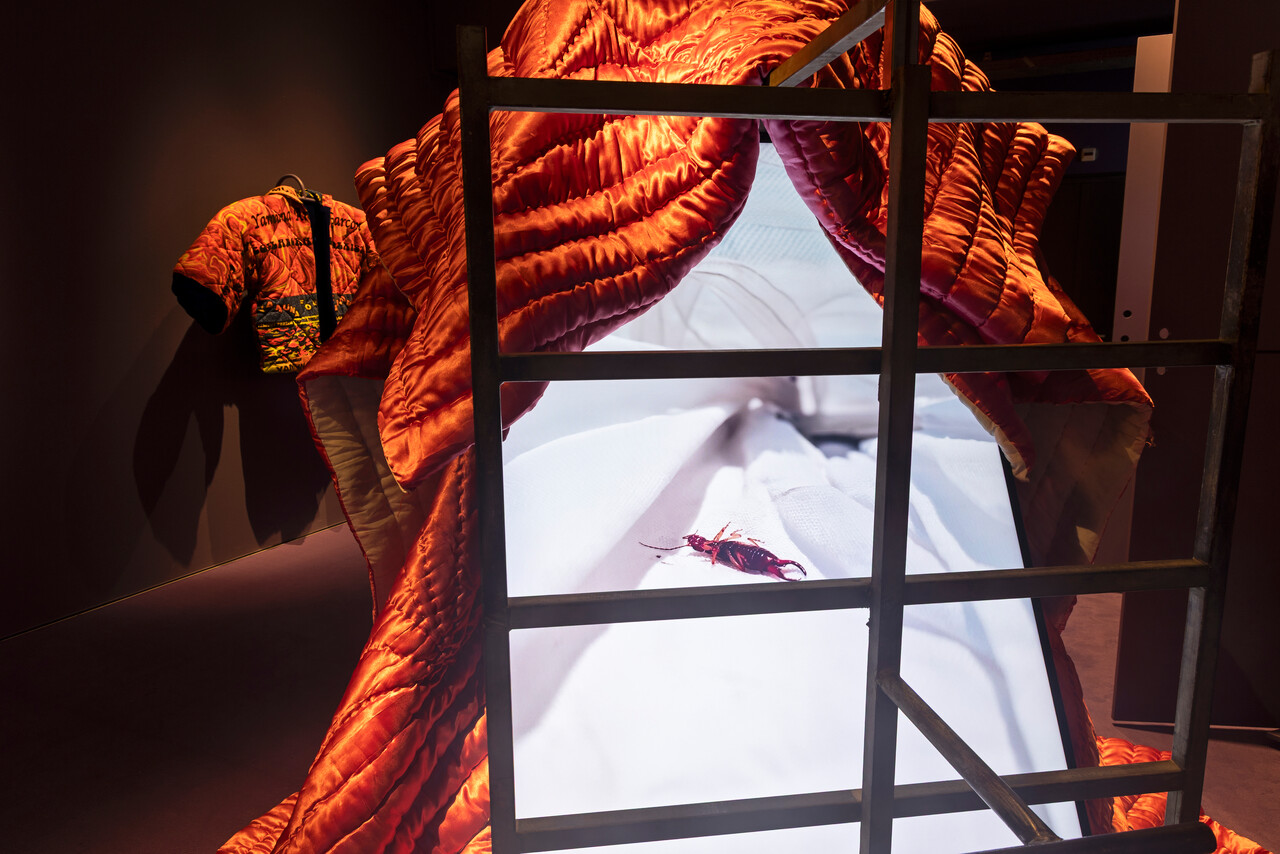
Hidden stories #13
8 March 2026
Queer histories: remembering, healing, speculating
Queer histories are often fragmented, silenced, or erased. In this article, conservator and curator Adelheid Smit explores how textiles can function as carriers of memory, healing, and imagination within LGBTQIA+ history. Drawing on the exhibition Haus of fibre at the Textile Museum, she shows how artists, through co-creation, personal narratives, and speculative history, make lost queer stories visible once more — not as something new, but as something that has always existed. Read the continuation of Hidden Stories #12.
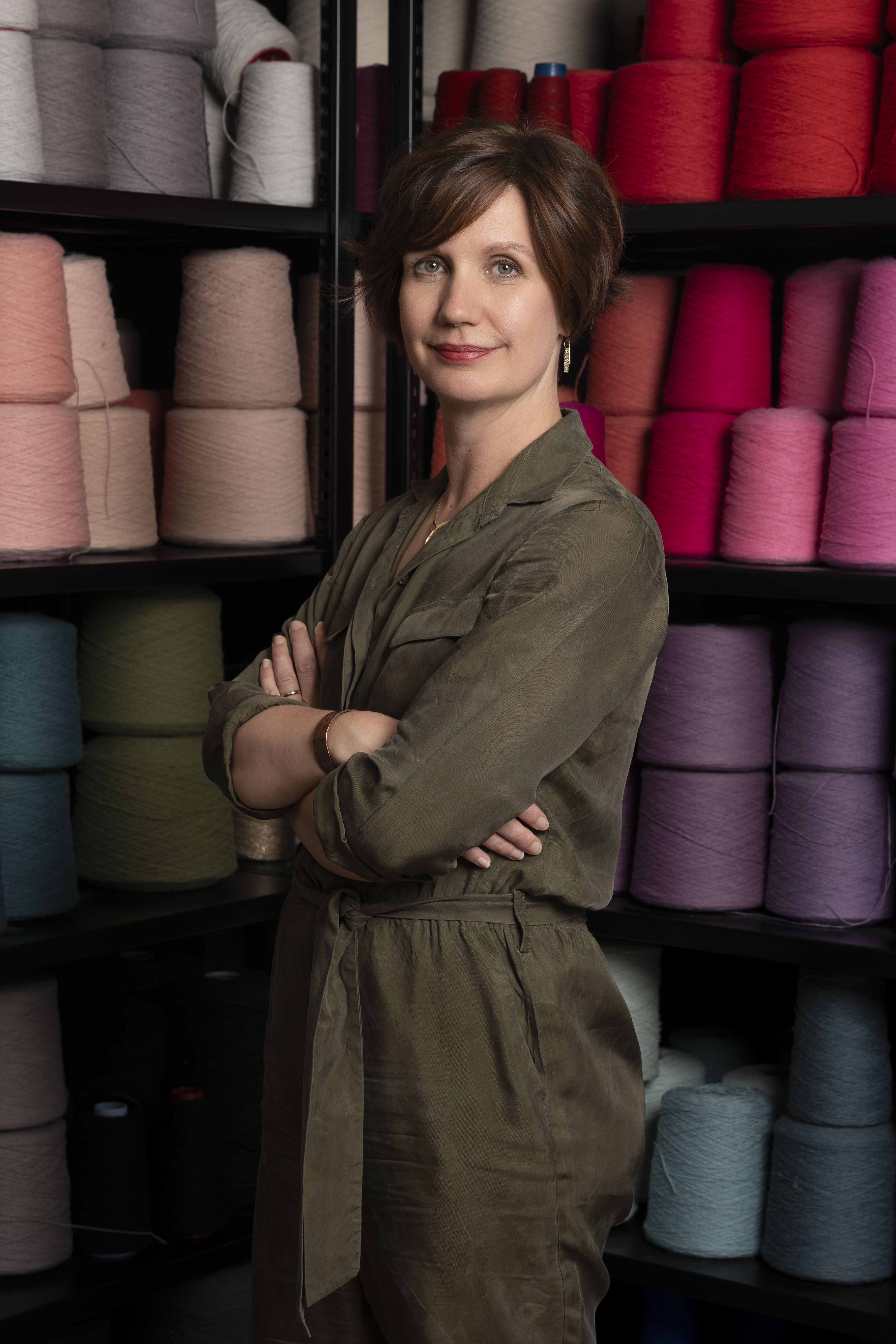
Photo by Patty van den Elshout for TextielMuseum
We were always here
In the bedroom, different kinds of relationships take centre stage, offering several examples of how we can rewrite art history. It also becomes visible here that queerness has always been part of our identity: that of the TextielMuseum in particular, but also of Tilburg and Brabant in a broader sense.
Our own collection, for instance, contains a great deal of work by the artist Harry Boom. In the 1970s he was one of the most prominent fibre artists in the Netherlands and made an important contribution to the recognition of textile art as an autonomous art form. His work has often been interpreted within this art-historical context, drawing connections with movements such as Minimal Art and the ZERO movement, as well as (as in our previous exhibition) with fibre artists such as Magdalena Abakanowicz.
Harry Boom was openly gay, yet this was rarely, if ever, discussed in relation to his artistic practice in exhibitions and publications. During our collection research for the exhibition, however, we encountered several works in which traces of his personal world can indeed be read. One example is Black Lover II from 1972. The erotic title of the work is reinforced by the artist’s choice of materials: the leather-like material and ropes evoked associations with the leather and kink subculture among the members of the co-creation group.
In the 1970s, within an art world still strongly oriented towards a rather masculine visual language, it was far less common for artists to allow their sexual orientation to inform the content of their work. Consider, for example, the aesthetics of Minimal and ZERO art, which also inspired many artists working with textiles. Following this aesthetic also offered greater assurance that one’s work would be valued as autonomous art rather than categorised as “textile art”.
By presenting this work in Haus of Fibre, we add a new dimension to Harry Boom’s oeuvre. Although we do not wish to retrospectively impose the idea that he intended to represent a lover in leather, it is nevertheless possible to read this as a form of ‘queer coding’* and thereby open the work up to broader interpretations.
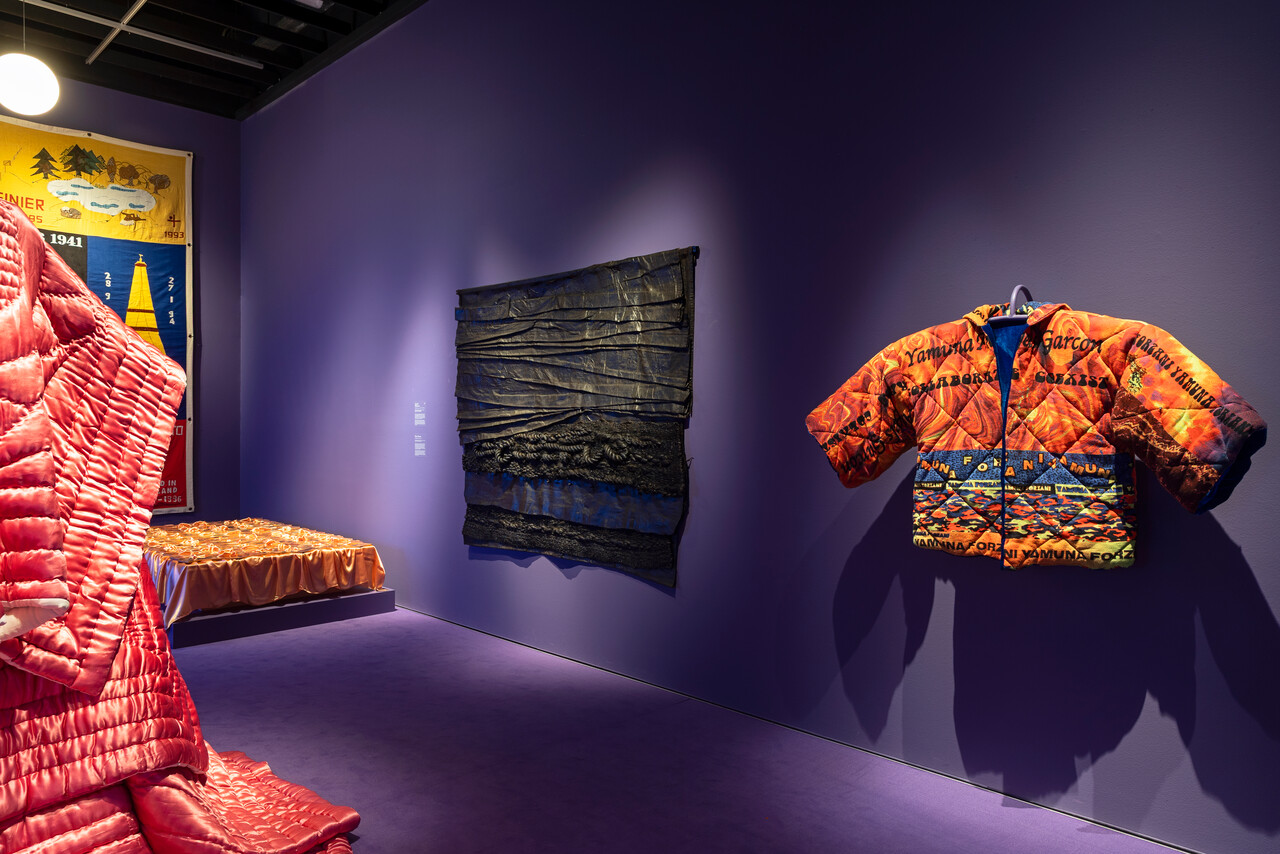
Black Lover II (middle). Photo by Josefina Eikenaar for TextielMuseum
We were here in Brabant too
At the back of the bedroom hangs an enormous quilt measuring 3.7 by 3.7 metres, which we have been able to borrow from Het Noordbrabants Museum. The quilt was made by members of the Brabant chapter of the HIV Vereniging and forms quilt block 16 of the Dutch Nederlandse AIDS Memorial Quilt from 1997.
The HIV/AIDS epidemic of the 1980s and 1990s left deep wounds in the queer community and continues to echo in the lives of those left behind. This quilt was part of the international The NAMES Project AIDS Memorial Quilt, in which large quilts were created bearing the names of people who died of AIDS. It served both as a way to mourn loved ones and as a form of protest. The project spread across the world and contributed to the (partial) reduction of the stigma surrounding the disease, while also helping to stimulate research and improve care.
This particular quilt shows that this was not solely a phenomenon of the Randstad, but that the HIV/AIDS epidemic is also part of the local history of Brabant — and therefore of our collective identity.
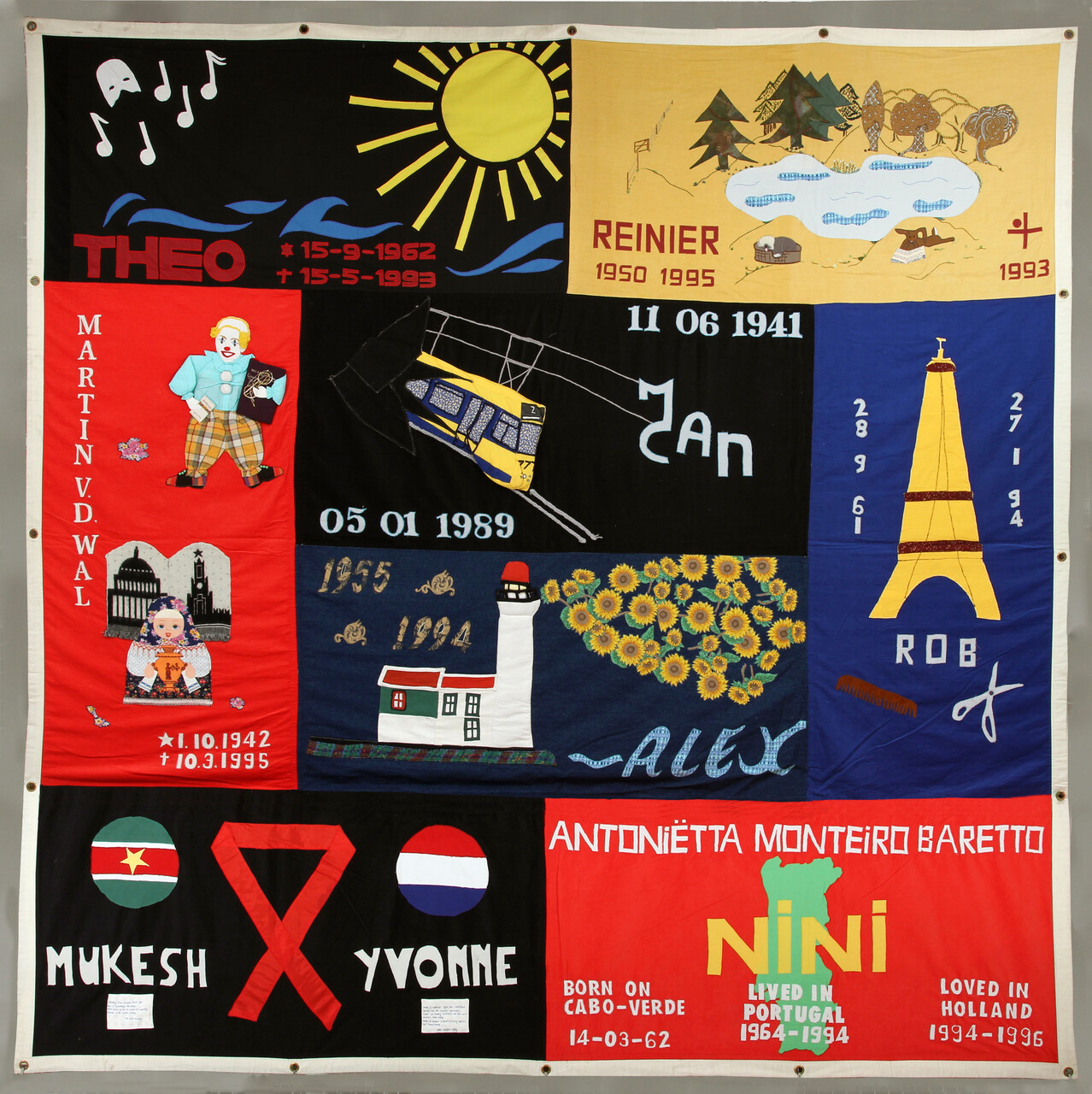
Photo by Het Noordbrabants Museum
Speculation
As mentioned, much of the history of LGBTQIA+ people was never documented or was deliberately erased. This can make it difficult to tell older stories, even though we were keen to do so for this exhibition. For the oldest object in Haus of Fibre, we therefore allow ourselves a certain degree of speculation. Reading between the lines and embracing the suggestive is an important queer method for making visible lives that could not, or cannot, reveal themselves openly.
In his research for the exhibition, Célio Braga discovered a garter dating from around 1800 in the collection of the Rijksmuseum that invites a hidden meaning to be unravelled. The garter bears the text “SI ME AMAS COMO DICES – LOS DOS SOMOS FELICES”, meaning: “If you love me as you say, we will both be happy.” There are no initials, no wedding date, and no further clues as to the sender. The message is clearly affectionate, but also expresses vulnerability and uncertainty. Reading between the poetic lines, Célio suggested that this might once have been a gift from a woman to her secret female lover.
We will never know for certain—and that is not the aim. Why should one have to prove that a historical object belonged to a queer person, when heterosexuality, by contrast, is rarely required to be established as a fact and is simply assumed? The value of this speculation lies not so much in uncovering the truth as in questioning the heteronormative assumptions that shape our perception of history.* Relationships that exist outside the hetero-cis norm have always existed. Their spirit may live on in our heritage, but above all in our imagination—because without imagination, those friendships and loves could not exist at all.
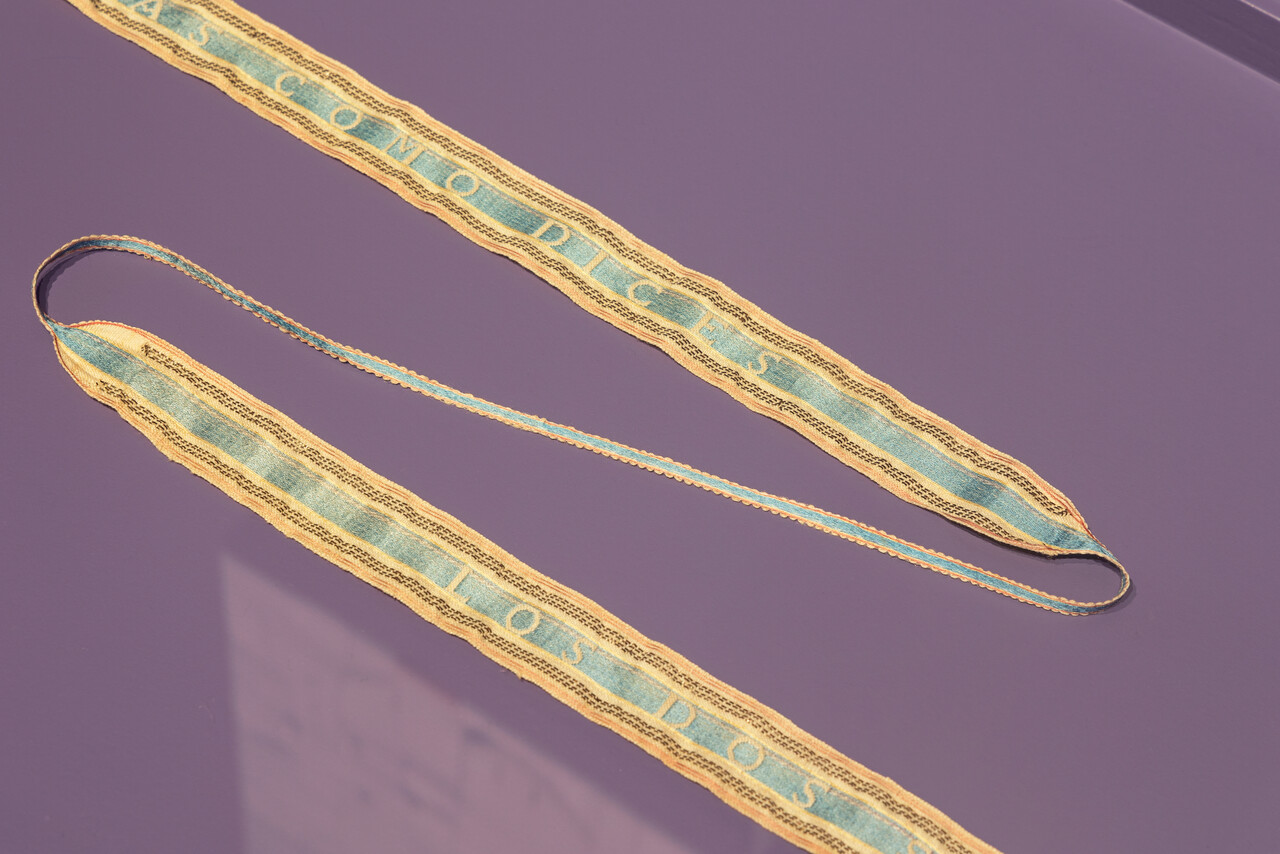
Garter. Foto door Josefina Eikenaar i.o.v. TextielMuseum
Looking forward means looking back
That imagination, dreams, and the courage to think beyond existing frameworks are essential to queer existence becomes most explicit in the garden. The garden forms a metaphor for a queer utopia in which LGBTQIA+ people are not only safe but able to flourish. Many artists choose artistic forms that depict animal, plant, and fungal life, emphasising queerness as a natural phenomenon.
The work of Damien Ajavon (they/them) shows that queer visions of the future remain deeply intertwined with queer history. In their installation Sérénade Enchantée: Mélody de Refuge, the Senegalese, Togolese and French artist explores the idea of the secret garden as a place of refuge. In a wall hanging and a floor piece, a beautiful garden filled with flowers unfolds, populated by various performance personas of the artist. At the centre is the queer fairy, the creator of this queer paradise.
Damien uses symbols from different cultures to shape this sanctuary. With the title, for instance, they refer to historic French gardens—such as those at Palace of Versailles—which were deliberately designed to allow visitors to lose their way and perhaps hide away (with a lover?). At the same time, many of these gardens were built with wealth accumulated through colonial violence, and botanical gardens in particular played a major role in colonial trade systems and their structures of oppression.
On the walls beside the wall hanging are ceramic Hamsa hands, an ancient Arab symbol of protection. This raises the question of who this garden can truly serve as a refuge for. The flowers growing in the garden—both on the wall hanging and the floor piece—are different species that have historically symbolised particular queer identities. The violets, lavender and roses in Damien’s garden symbolise the lesbian, gay and trans people of the past, who form the fertile ground for a possible queer future in which they will be remembered with care as kin ancestors.
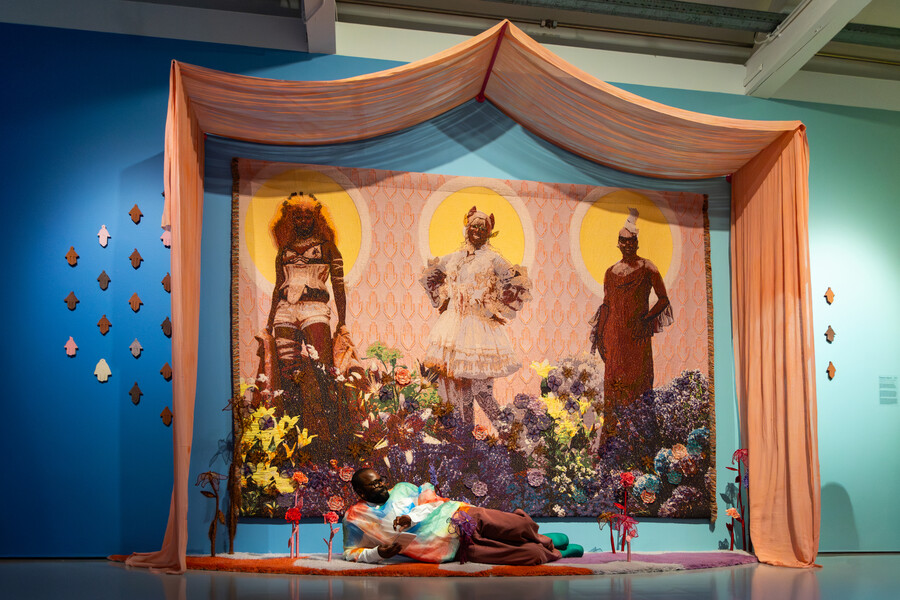
Damien Ajavon in Sérénade Enchantée: Mélody de Refuge. Photo by Daily Catch for TextielMuseum
Plan your visit
Buy a ticketWritten by Adelheid Smit, curator collections at the TextielMuseum.
Would you like to see more of our museum collection or the (upcoming) exhibitions?
Share with friends